


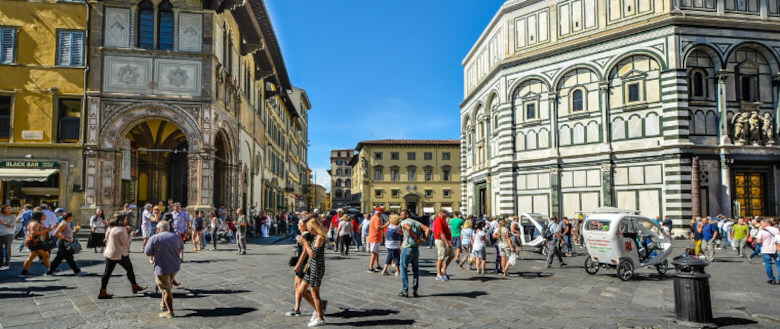
Florence isn’t just a backdrop for art history; it’s arguably the best classroom in the world. If you’re serious about learning Italian—whether for a quick week-long reset or a deep-dive immersion—there are a few things you should know before you pack your bags for Tuscany to enjoy an Italian course in Florence.
This article was published on May 9, 2021, and last updated on March 2, 2026
Why learn Italian in Florence?
The city is stunning, sure, but it’s also incredibly lived in. Because the historical center is relativelycompact, you don’t need a car or a complicated map; you can just wander. You’ll find yourself ducking into narrow medieval alleys and stumbling upon “hidden treasures”—from tiny leather workshops to hole-in-the-wall wine windows—just by getting lost on your way to class.
It’s also the perfect “home base.” Since the city is so well-connected, your weekends are basically sorted. You can hop on a quick train to explore the walls of Lucca, the towers of Siena, or the leaning tower in Pisa. If you’re more into scenery, the Chianti vineyards are right on your doorstep.
Did you know that Florentine Italian inspired Dante, Petrarch, and Boccaccio? Because of their literary influence, the Florentine dialect essentially became the blueprint for Standard Italian.
Top 6 tips for making the most of your Italian course in Florence
Understand the character of the Florentines
Florentines are very ironic: they tend to tease with a subtle kind of irony. This might be difficult for some foreigners to understand, and some might even feel offended by the way locals express themselves. Far from it: the most important rule is to not be offended but to roll along with the jokes!
The “local” Italian language
Despite living in the cradle of the Italian language, locals have their own way of pronouncing some things. The most obvious example is the letter “C”, which sounds like an “H”. Don’t get discouraged if you don’t understand everything, it’s normal. Another peculiarity is that, in Florence, the word for papà (dad) is babbo. Locals cannot stand having their father being called papà… anyone who studies Italian in Florence must know this!
Need a public bathroom?
There aren’t any in Florence! Therefore, our tip is to buy something at a coffee bar so that you can use its restroom, or you can use the ones in the museums. The only decent pay toilet is in the Duomo, next to the pharmacy.
A cold cut that you can’t find elsewhere
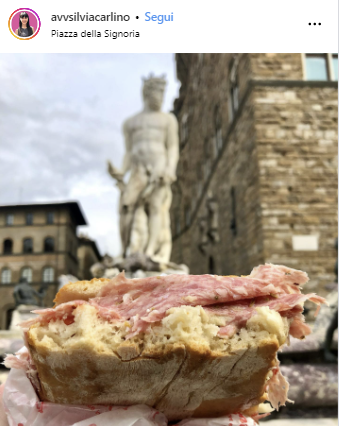
When taking a break from your Italian course in Florence, you can enjoy a snack with the ‘finocchiona’. It’s a type of salami with a fennel essence! And you can’t find it anywhere else in Italy.
Only locals know about this museum
The ‘Misericordia di Firenze’ Museum is a true hidden gem that only the Florentines visit. It tells the story of the city through the Misericordia, an association that was born 700 years ago and has become an example of boundless charity. The 600m² museum winds through 14 rooms!
Our insider tip
When you study Italian in Florence and want a quiet, inspiring corner where to read or where to simply soak in the authentic beauty of the city, go to Piazza del Limbo. This is a small, ancient and charming square is in the city centre, yet very few tourists pass here. Among the buildings that overlook the square are the Church of Santi Apostoli, one of the Florentine churches that has maintained an early medieval aspect inside.
What to expect from an Italian course in Florence with Studiainitalia
- Tiny classes: You won’t be hidden in a lecture hall. Most groups are just 4 to 8 people for personalized attention.
- Real-world practice: Your “homework” usually involves ordering a cornetto at the local bar or navigating the Central Market.
- Beyond the classroom: It’s not all grammar drills. Lessons often include cooking classes, art tours, and local excursions.
- Your schedule, your call: You can stay for a one-week intensive sprint or settle in for a full six-month sabbatical.
Ready to start your Italian journey?
Want to learn Italian in Florence with a certified school that offers personalized lessons, cultural immersion, and flexible schedules? Book your Italian course in Florence today — we’ll help you find the perfect fit.
Buon Italiano a tutti!
Recommended websites for more tips on Florence:
Sarah’s Florence, l’inflorencer – a blog with lots of curiosities about the city.
WikiPedro – a Youtube channel with videos dedicated to corners off the beaten path and art history.
Lost in Florence – great resource if you are more interested in food, wine and chic shops.
Frequently Asked Questions about Italian courses in Florence
Is Florence a good place to learn Italian?
Yes. Florence offers the most authentic standard Italian, with immersive cultural experiences and accredited language schools.
How much does an Italian course in Florence cost?
Prices range from €320–€810 per week depending on duration, class size, and included activities.
How long should I study Italian in Florence?
2–4 weeks is ideal for beginners to build confidence. Advanced learners benefit from 6+ weeks for fluency.
Can I learn Italian in Florence without knowing any Italian?
Absolutely. Most schools offer beginner courses with full support in English.
If you have already studied Italian in Florence: did we miss any tips in your opinion? Comment below!
Cover photo by user32212 from Pixabay